Sanjiv Puri on Rebuilding ITC's Cigarette Business After a Tax Shock Nobody Could Plan Around
The ITC Chairman explains how a 115-year-old conglomerate absorbs a sudden tax hike on its most profitable segment while still chasing a ₹20,000 crore expansion elsewhere
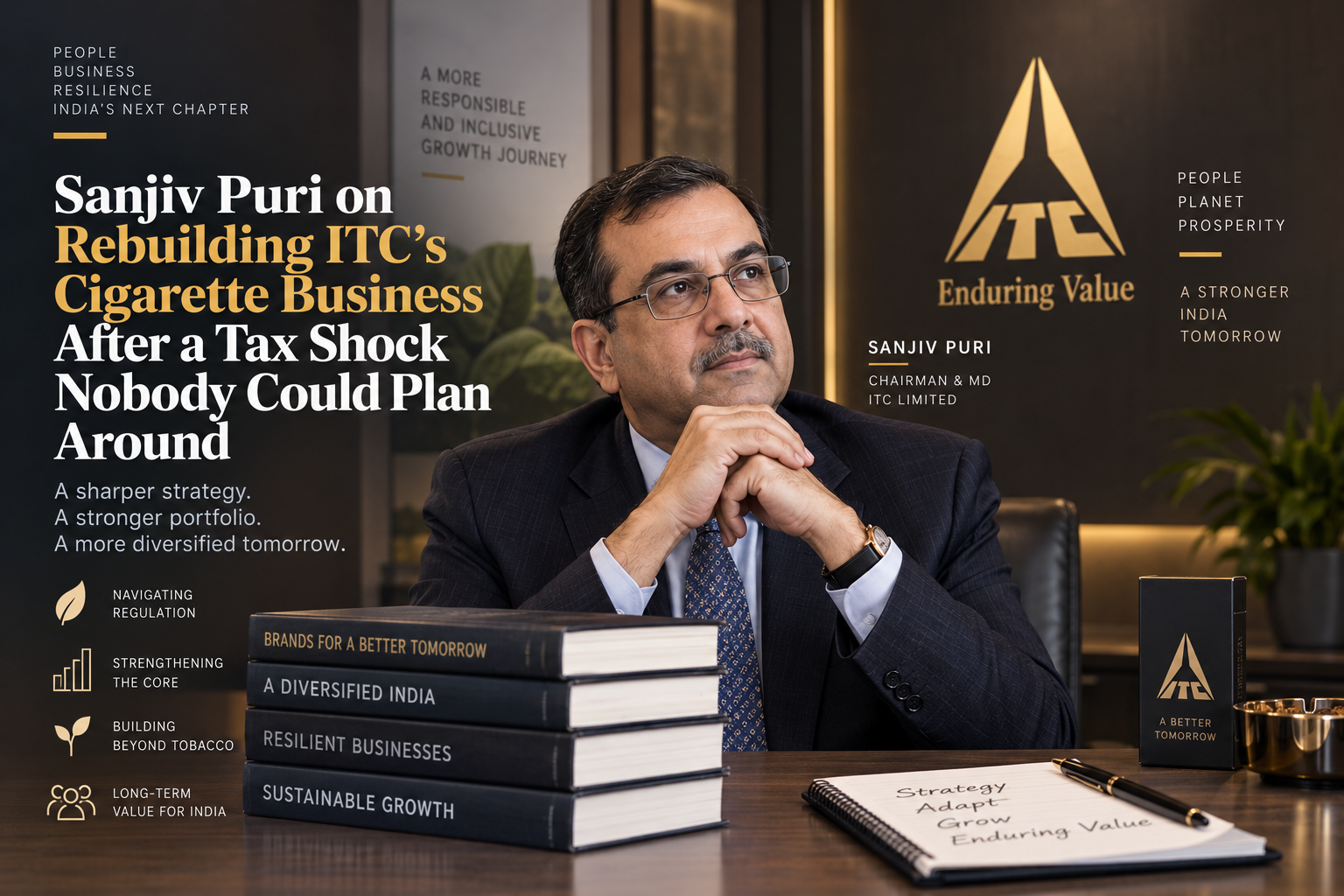
Sanjiv Puri took over as ITC's Chairman and Managing Director in 2019, succeeding the legendary Y.C. Deveshwar, and has spent his tenure executing a diversification strategy — ITC Next, unveiled in 2017 — aimed at reducing the conglomerate's historical dependence on cigarettes. That strategy faced its sharpest real-world test this year, when India's tax structure on cigarettes was revised effective February 1, 2026, raising the GST levy from 28 percent of transaction value to 40 percent of retail sale price, alongside a sharp increase in excise duty following the phase-out of the compensation cess.
Managing a Shock to the Core Business, in Public
Puri's response, laid out at ITC's shareholder meeting, was notably candid for a chairman discussing his company's single most profitable segment. He acknowledged there will be "challenges for some time" from the tax increase, while describing the company's approach as a calibrated pricing strategy designed to minimise the risk of consumers shifting to the illicit cigarette market — a genuine concern in India, where a large untaxed and unregulated cigarette trade competes directly with legal manufacturers whenever legal cigarette prices rise sharply. Puri framed the response as twofold: careful pricing to avoid pushing volume into illicit channels, and continued portfolio innovation to rearchitect the cigarette business around the new tax reality rather than simply absorbing the hit passively.
The Diversification Numbers That Give Him Room to Absorb the Shock
What makes Puri's calm public tone credible is the diversification track record he can point to. He noted that non-cigarette businesses accounted for just 17-18 percent of ITC's bottom line when the ITC Next strategy launched in 2017; by the time of the hotels demerger, that share had risen to 25 percent, and more recently ITC has said 65 percent of its total revenue now comes from non-cigarette businesses under what the company calls its "Bharat First" strategy. Over the same broad period, ITC's overall bottom line doubled from roughly ₹10,000 crore to ₹20,000 crore — growth Puri has directly credited to the pace at which the newer FMCG, hotels (pre-demerger), agri-business and paperboards segments have been scaling, faster than the legacy cigarette business.
A Specific, Sizeable Bet on FMCG Leadership
Puri has been explicit about where ITC's next phase of growth is aimed: becoming India's largest FMCG player, built on a strategy of expansion, premiumisation and a "future-ready portfolio" spanning staples through premium categories. At ITC's 2025 AGM, he unveiled a ₹20,000 crore expansion strategy, and has spoken separately about FMCG exports becoming a substantial contributor to the company's growth as ITC brands move into international markets, not just scale domestically.
Reading Consumption Signals in Real Time
Puri has also positioned himself as a close reader of consumer sentiment tied to policy. Following the government's GST rate cuts effective September 2025, he argued that consumer psychology matters as much as the underlying arithmetic — when the message reaches ordinary consumers that prices have genuinely come down, it "allows people to open their purses" in a way that creates a broader multiplier effect on volume, employment and investment, not merely a one-time price adjustment. That framing, paired with his AI and digital commentary in earlier interviews about combining machine intelligence with human judgment and decades of institutional practice, reflects a leadership style built around translating macro policy signals into operational and pricing decisions quickly.
Why It Matters for Market Leaders
Puri's public handling of the cigarette tax shock is a useful study in how a market-leading conglomerate manages a sudden, externally imposed hit to its most profitable business line without letting it derail a much larger diversification strategy already years in motion. Rather than downplay the disruption or over-promise a quick fix, he's chosen to name the challenge directly, explain the specific mechanism (illicit trade risk) driving his pricing caution, and point to a decade of diversification numbers as evidence the company has genuinely reduced its dependence on the segment now under pressure.
Executive Interviews
At www.elevatexstudios.com / ElevateX Studios, Executive Interviews, part of our Market Leaders coverage, brings you conversations with the executives steering India's largest companies through their most consequential strategic bets.