At 92, R.C. Bhargava Is Still Telling India's Auto Industry What It Doesn't Want to Hear
The Maruti Suzuki chairman who launched the Maruti 800 in 1983 is now questioning government mandates and defending small cars as India's real mobility future
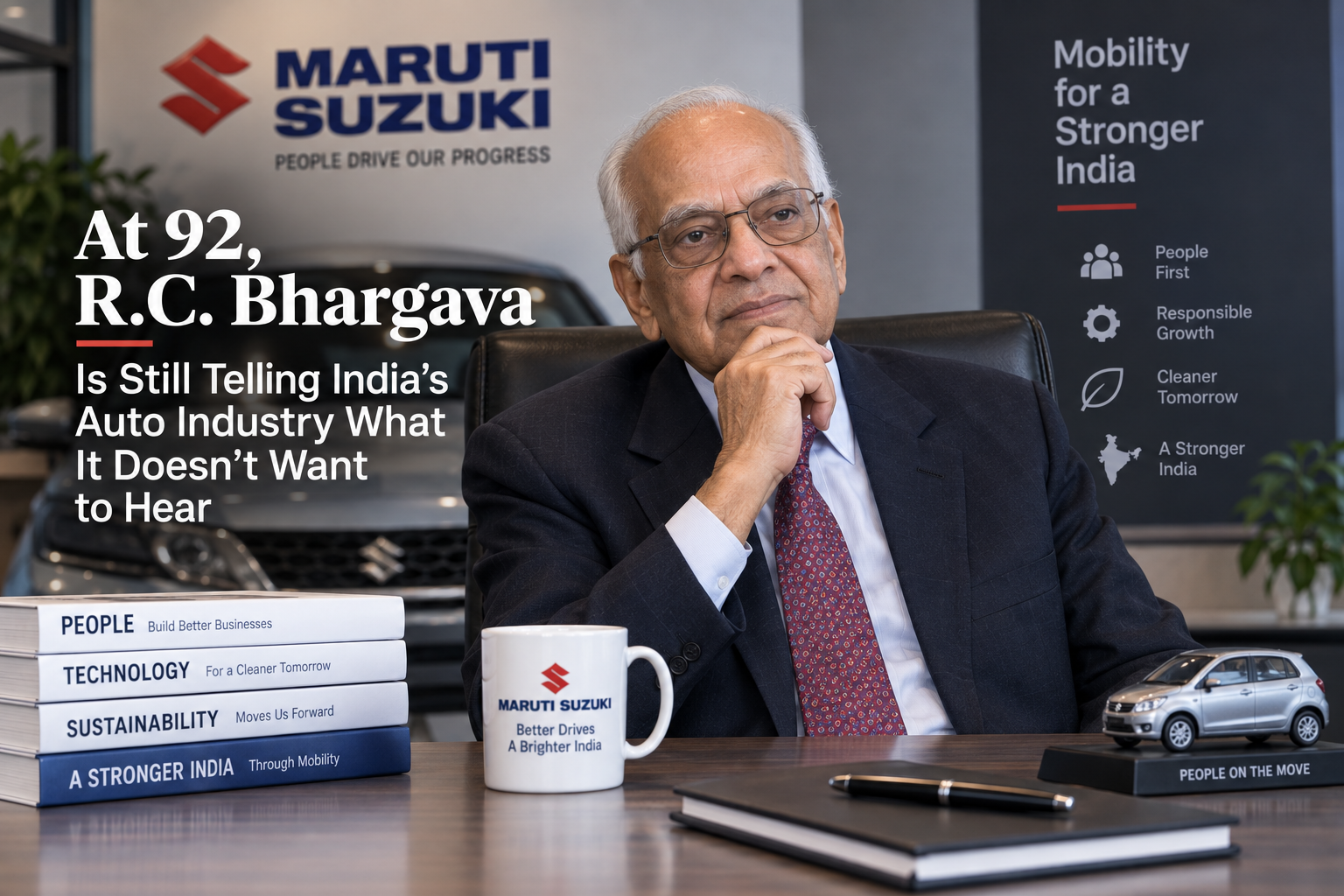
Ravindra Chandra Bhargava joined what was then Maruti Udyog Limited in 1981 after 25 years as an Indian Administrative Service officer, and has remained at the company in some capacity ever since — as CEO, then as chairman since retiring from executive duties in December 2007. He was present when Prime Minister Indira Gandhi handed over the keys to India's first Maruti 800 in December 1983, a car the company could only produce 20,000 units of in its first year against 120,000 bookings. More than four decades later, at 92, he remains one of the most quoted voices in Indian auto policy — and one of the most willing to publicly disagree with where the industry, and the government, are headed.
Defending Small Cars Against a Shifting Market
Bhargava has spent much of 2026 making a specific, repeated argument: India is not a rich country, and its mobility future has to be built around low-cost small cars, not the SUVs the market has been shifting toward. Speaking after Maruti Suzuki's fourth-quarter earnings, he pushed back on the idea that entry-level and two-wheeler buyers have simply become more aspirational and moved toward mid-sized cars — his read is that vehicle prices at the entry level rose faster than buyer incomes over the past several years, suppressing demand rather than buyers outgrowing the segment. He's pointed to the government's GST rate cut as the mechanism that should gradually reverse six years of declining small-car share, arguing the shift is "inevitable" once affordability catches back up with demand.
Unbothered About Market Share, On Purpose
On Maruti Suzuki's declining domestic market share — now below 40 percent — Bhargava has offered a notably unsentimental response: the company is running at 100 percent production capacity and prioritising exports "in national interest," so market share erosion doesn't concern him as long as the company is profitable on every car it sells. It's a deliberately counterintuitive position for the chairman of India's largest carmaker to take in public — treating market share as a secondary metric to capacity utilisation and export commitments, rather than defending it as an end in itself.
Questioning a Government Mandate Most Companies Wouldn't Touch Publicly
Bhargava's willingness to publicly challenge policy extends to regulation that directly affects his own industry. In August 2026, he openly questioned the government's proposal to make vehicle-to-vehicle communication systems mandatory on all new vehicles from October 2028, asking pointedly what car users in rural areas or in cities where traffic moves at 30-40 km/h would actually gain from the technology. It's a rare instance of an industry chairman directly challenging a safety-technology mandate rather than accepting it as a cost of doing business — a posture that carries real weight given Maruti Suzuki's scale and Bhargava's decades of credibility with policymakers.
A Track Record That Backs the Bluntness
Maruti Suzuki's FY26 numbers give Bhargava's confidence real grounding: revenue of ₹187,673 crore, net income of ₹14,679 crore, and production of over 2.4 million units at close to 100 percent capacity utilisation. The company has lined up ₹14,000 crore in fresh capex for FY27, including new production lines in Kharkhoda, Haryana and a new site in Gujarat — continued expansion even as domestic market share slips, consistent with Bhargava's stated priority of capacity utilisation and export volume over share of a single market.
Why It Matters for Market Leaders
Bhargava's continued candor at 92 — pushing back on regulation, defending an unfashionable product segment, and treating market share as secondary to profitability — is a useful reminder that genuine industry leadership sometimes looks less like consensus-building and more like a willingness to say the unpopular thing loudly and repeatedly until the data catches up. Few industry figures anywhere have the standing, built over more than four decades at a single company, to challenge a government mandate in the press and have it taken seriously rather than dismissed as self-interested pushback.
Industry Leaders
At www.elevatexstudios.com / ElevateX Studios, Industry Leaders, part of our Market Leaders coverage, profiles the figures whose decisions and public positions shape the direction of entire Indian industries, not just their own companies.