C S Setty Is Betting SBI's Next Decade on AI Reaching Places Banking Never Has
The SBI Chairman has spent his tenure listing subsidiaries, defending capital ratios, and now arguing that AI's real test isn't retail banking — it's rural India and the customers no scorecard was built for
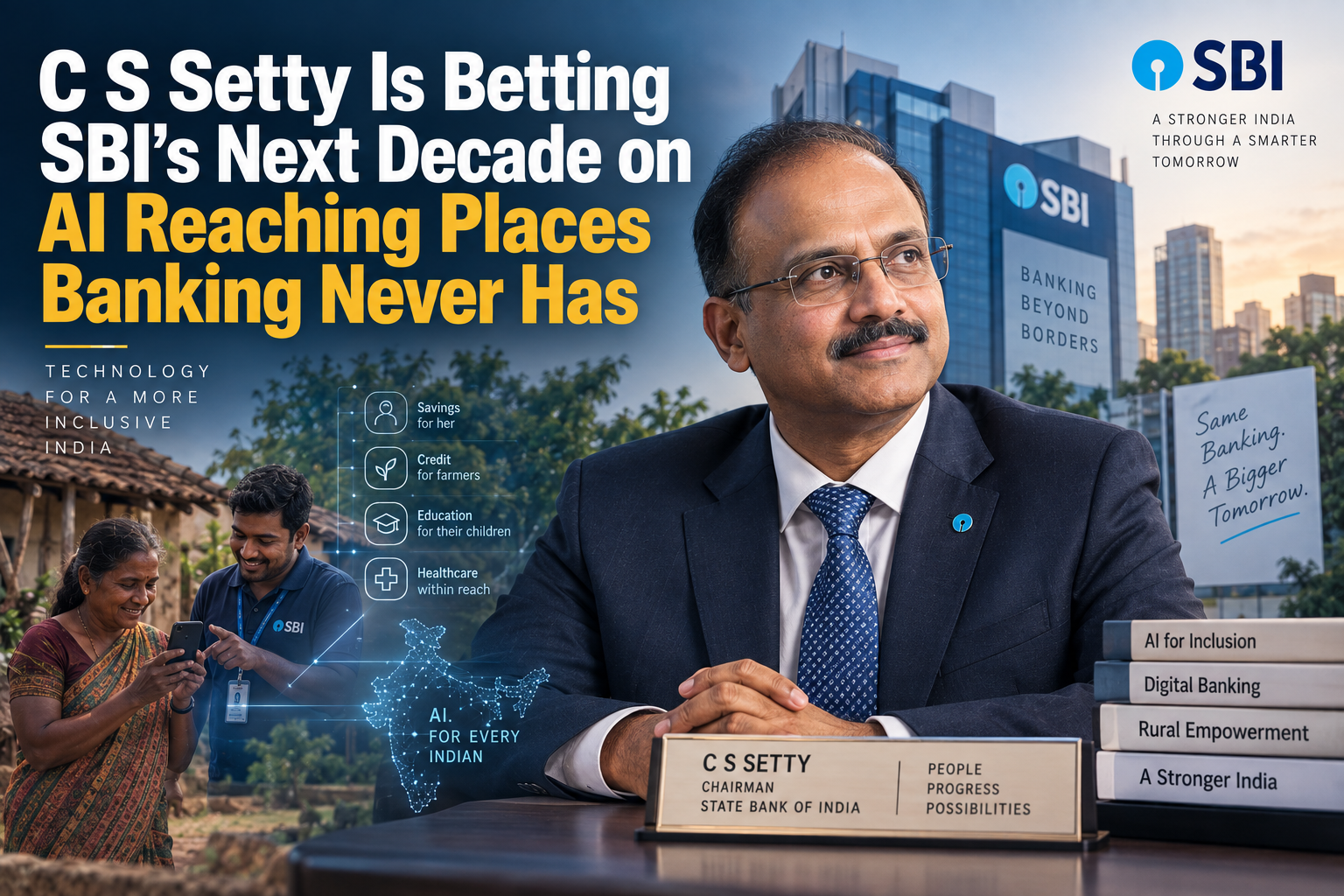
Challa Sreenivasulu Setty took over as Chairman of State Bank of India — the country's largest lender — on August 28, 2024, succeeding Dinesh Khara. As the senior-most managing director at the time, Setty's elevation followed convention rather than surprise, but his three-year term has since been defined by a specific set of priorities he's returned to consistently across public appearances: capital strength, capital-markets depth, and, increasingly, what AI can actually do once it moves past the parts of banking that are already comfortable using it.
Guarding SBI's Balance Sheet First
Early in his tenure, Setty was explicit about capital discipline as a precondition for growth, not an afterthought to it. He set a target of maintaining at least 15 percent capital adequacy ratio with a 12 percent CET1 buffer through March 2026, framing the goal less as a regulatory checkbox and more as a signal of resilience to an industry watching how India's banking sector absorbs future shocks. SBI raised ₹25,000 crore in equity capital from institutional investors in the second quarter of FY26 to help hit that target, alongside benefiting from its earlier divestment in Yes Bank.
Setty has also been willing to make forward-looking calls that carry real reputational risk if they don't land: he's said he expects three Indian banks — SBI among them — to rank among the world's top ten by market capitalisation by 2030, a specific, publicly stated benchmark that gives analysts a clean way to judge his tenure against his own stated ambitions.
Unlocking Value Through Subsidiaries, Carefully
A meaningful part of Setty's strategy has involved selectively listing SBI's subsidiary businesses rather than treating the parent bank as the only vehicle for growth. SBI Funds Management made its stock market debut in July 2026, listing at a premium over its issue price. Setty was direct that the bank does not plan further dilution in the asset manager beyond the listing, and that other unlisted SBI subsidiaries still need to reach greater scale and maturity before an IPO decision would even be considered — a deliberately unhurried approach to monetising the group's broader financial ecosystem, built around more than 530 million customers and the largest deposit and advances market share in the country.
The AI Argument That's Become His Signature Message
Setty's most consistent recent theme, repeated across venues from the FIBAC banking conference to public remarks on India's Viksit Bharat 2047 ambitions, is that AI's real economic impact in banking hasn't happened yet. He's argued that the technology has so far mostly improved retail banking — customer understanding, service quality, credit risk assessment — but that the more consequential opportunity is using AI to extend banking into rural India, small businesses, and customers whose financial histories don't fit conventional lending models. Agriculture, in his framing, is a particularly underexploited use case, where AI-supported farm-level decisions and data-driven risk assessment could open credit access that traditional underwriting has historically excluded.
He's paired that argument with a broader economic case: India's manufacturing share of GDP needs to rise from 17 percent to at least 25 percent, renewable energy already meets more than half the country's electricity demand — five years ahead of its 2030 Paris Agreement target — and India's energy transition alone will require roughly $22 trillion in cumulative investment by 2070. In that context, Setty has urged investors to look past headline Sensex movements toward these structural, multi-decade shifts as the more meaningful measure of the economy's direction.
Why It Matters for Market Leaders
Setty's tenure at India's largest bank is a useful study in how a market leader defends its position while quietly repositioning for the next decade — shoring up capital ratios before chasing growth, monetising subsidiaries on a deliberately conservative timeline, and staking his public credibility on a specific, falsifiable claim about where AI's next wave of value creation in Indian banking will actually land. For a bank serving over half a billion customers, that combination of caution and directional conviction may be exactly the balance the role requires.
CEO Profiles
At www.elevatexstudios.com / ElevateX Studios, CEO Profiles, part of our Market Leaders coverage, looks at the executives currently running India's dominant companies — how they got the job, what they inherited, and what they're being judged on next.