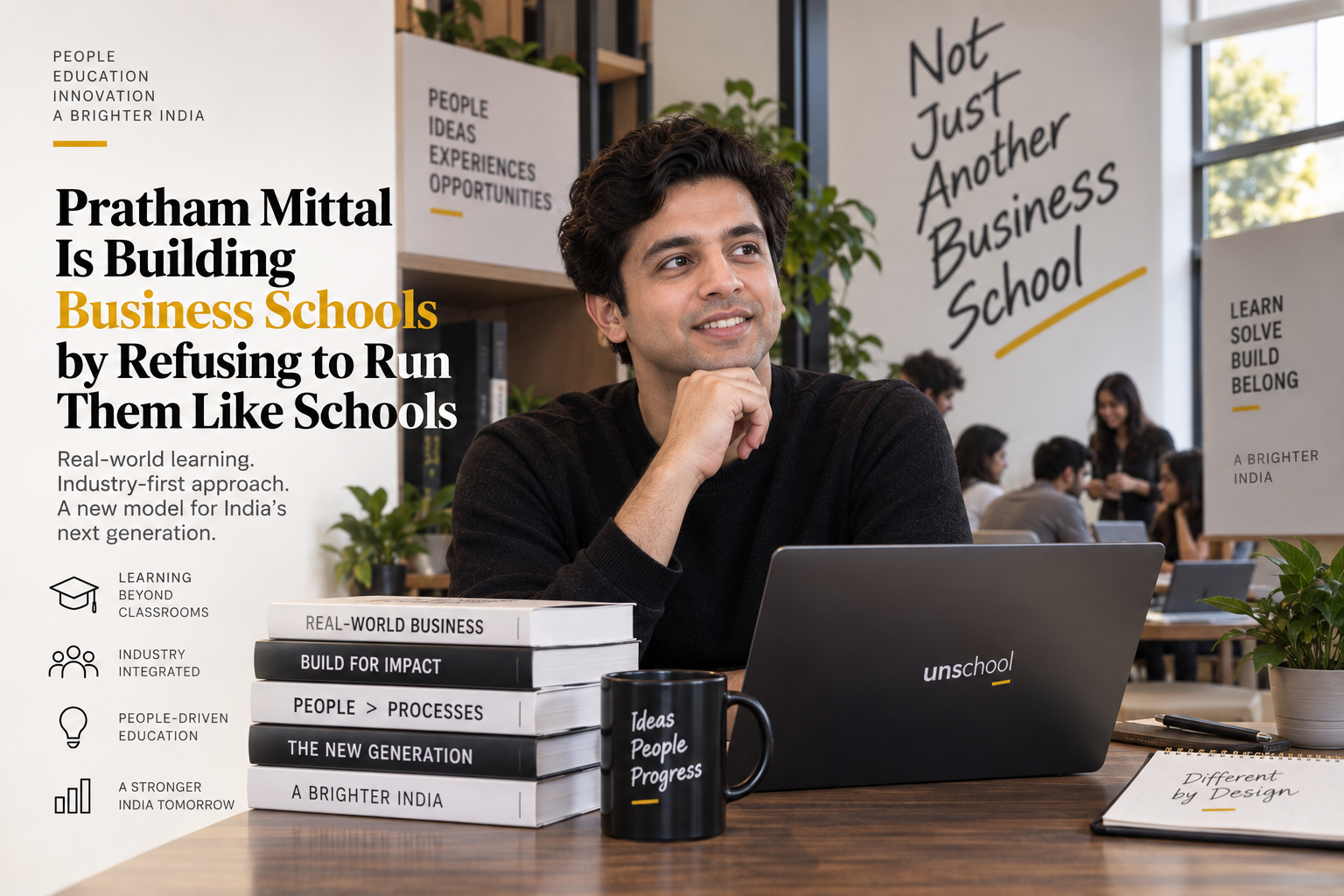
Pratham Mittal Is Building Business Schools by Refusing to Run Them Like Schools
The Tetr College of Business and Masters' Union founder wants his campuses in the world's top 10 within five years — using a model built entirely around learning by building real companies
Pratham Mittal grew up at The Doon School before heading to the Wharton School at the University of Pennsylvania to study computer science and economics. Of the roughly forty courses on offer at one of the world's top business schools, only one genuinely held his attention — a class taught by Adam Grant that had students work directly with local business owners on real problems, like redesigning a restaurant's menu or rebuilding a website to bring in more customers. That single course became the founding thesis for everything Mittal has built since: business is learned by doing business, not by reading about it.
Starting With a Company, Not a Classroom
Before he built a single institution, Mittal co-founded Outgrow in 2011, a New York-headquartered SaaS platform for building interactive content — quizzes, calculators, and similar engagement tools — that went on to serve more than 20,000 businesses globally, including Nike, Tesla and The New York Times. That early startup experience, rather than an education credential, became his actual qualification for building schools: he'd already run the kind of company he wanted his students to build while enrolled.
From Masters' Union to a Genuinely Global Campus
In September 2021, Mittal launched Masters' Union, a private business university in Gurugram built around a practitioner-led model — courses taught by industry CXOs, startup founders and venture capitalists rather than solely by career academics. The institution has since expanded from its original postgraduate technology and business management program into undergraduate degrees, executive education and a venture incubation track.
In January 2024, Mittal went further, launching Tetr College of Business — an undergraduate business school whose curriculum runs students through study periods across multiple countries, including the United States, Singapore, India, Ghana, Argentina, the UAE and locations across Europe. Tetr's inaugural cohort brought together 110 undergraduate students from 45 countries, delivering degrees through a partnership with Middlesex University via UBI Business School. The model attracted institutional capital quickly: Tetr closed an $18 million round co-led by Owl Ventures and Bertelsmann India Investments in its first institutional raise, with applications climbing 50 percent in its second year and student intake expanding to 200 students from 50 countries.
A Deliberately Uncomfortable Bet on Outcomes Over Prestige
Mittal has been candid that Tetr and Masters' Union are still, in his own words, "uncharted territory with results we're yet to see" — an unusually honest framing for a founder simultaneously building two accredited institutions. He's also been direct in his criticism of conventional Indian MBA programmes, describing many as having effectively become "placement agencies" rather than genuine centres of learning, a critique that positions his own schools as a direct structural alternative rather than an incremental improvement on the existing model.
The stated ambition is not modest: Mittal has said he wants Masters' Union and Tetr ranked among the world's top 10 business schools within five years — a target that would require competing directly with century-old institutions on reputation, not just on pedagogy.
A Family Business, Extended
Mittal's path into education wasn't entirely unprecedented within his own family — his parents founded and continue to serve as chancellors of Lovely Professional University in Jalandhar. But rather than join or extend that existing institution, he chose to build an entirely separate model from scratch, betting that an experiential, startup-embedded approach couldn't simply be grafted onto a traditional university structure.
Why It Matters for Young Entrepreneurs
Mittal's trajectory — from building a real company, to teaching others to build real companies as their actual coursework — is a useful example of a founder applying entrepreneurial instincts to an industry, education, that rarely gets disrupted by people who've actually built something themselves first. His own stated view is that entrepreneurship isn't a function of age or title; for a founder building institutions meant to shape how the next generation of entrepreneurs is trained, that's as much a personal thesis as an admissions pitch.
Young Entrepreneurs
At www.elevatexstudios.com / ElevateX Studios, Young Entrepreneurs, part of our Founder Stories series, tracks founders building ambitious companies early in their careers — the bets they made, the setbacks they absorbed, and what their journeys signal for the next generation of builders.