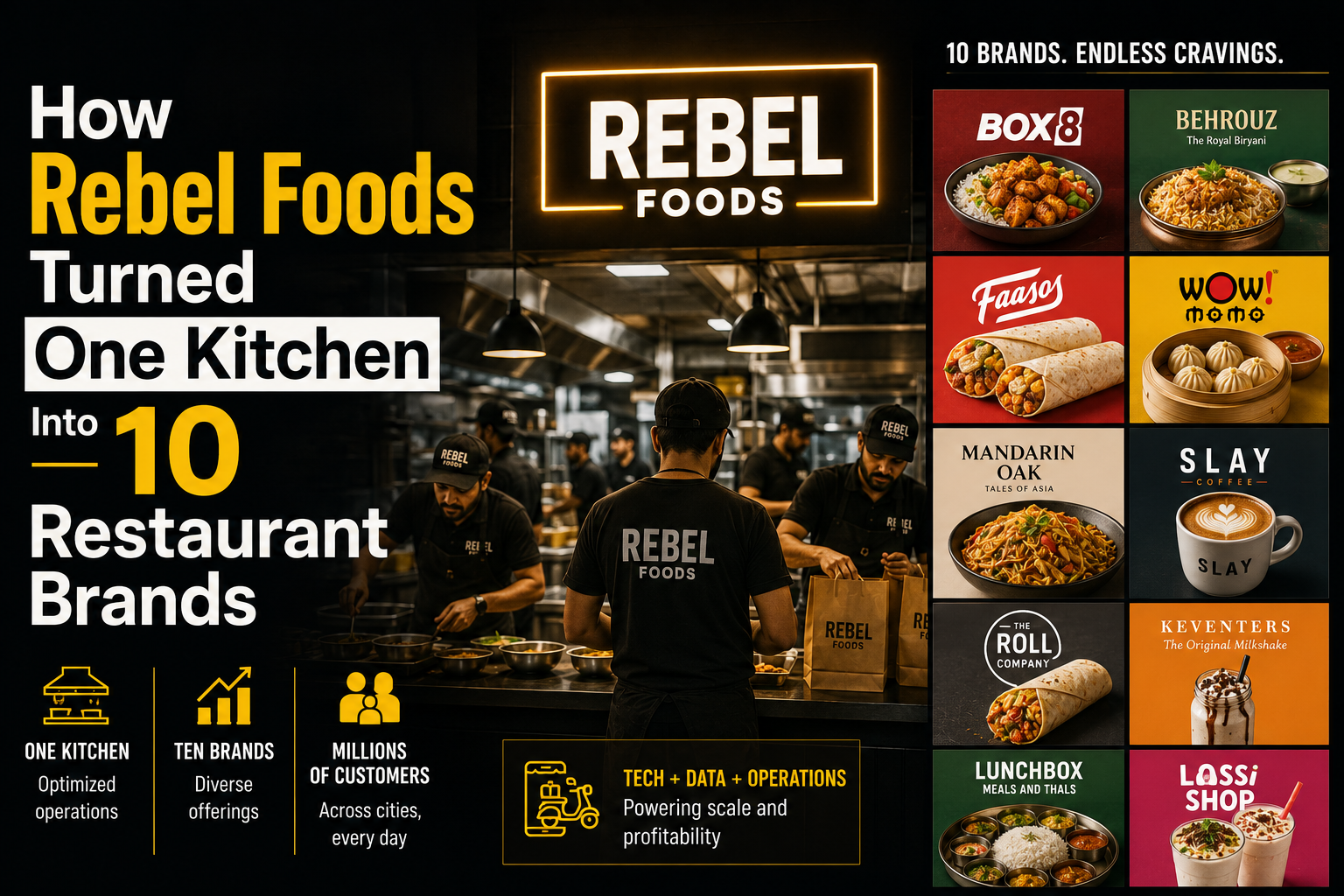
How Rebel Foods Turned One Kitchen Into Ten Restaurant Brands
Jaydeep Barman's core insight wasn't a better recipe — it was treating a kitchen as an asset to be filled, not a room attached to a single brand
Rebel Foods didn't start out as a cloud kitchen company. Founded in Pune in 2011 by INSEAD alumni and former McKinsey consultants Jaydeep Barman and Kallol Banerjee, the business launched as Faasos, a physical quick-service restaurant chain selling rolls and wraps. The pivot that defined everything that followed came around 2014, when the founders noticed that most of their orders were already arriving by phone or web, while high-street rents on their physical storefronts kept eating into margins. Rather than optimise the existing model, they shut the storefronts and moved entirely into delivery-only "shadow" kitchens — the decision that eventually gave the rebranded Rebel Foods its name.
The Strategy: Fill the Kitchen, Not Just the Menu
Rebel Foods' central growth insight is one that most restaurant operators don't apply: a single kitchen doesn't need to serve a single brand. Instead of building one restaurant concept and scaling it location by location, Rebel Foods runs multiple, independently branded restaurants — Behrouz Biryani, Oven Story Pizza, Mandarin Oak, The Good Bowl, Faasos and others — out of shared kitchen infrastructure, using shared staff, equipment and supply chains across brands that customers experience as entirely separate restaurants on delivery apps. The company now operates more than 450 of these dark kitchens across roughly 75 to 100 cities in India, alongside operations in the UK and UAE, with expansion plans aimed at 800 facilities across 200 cities by 2029.
Why the Model Actually Works
The multi-brand structure solves a problem that kills most single-brand delivery businesses: idle kitchen capacity during off-peak hours or slow days for any one cuisine. By running several brands with different peak demand windows and different customer segments out of the same physical space, Rebel Foods keeps utilisation high without needing to open new locations for every new concept it wants to test. The company has also leaned heavily into data and AI to support that structure — using demand prediction and menu optimisation across its brand portfolio to decide what to cook, where, and when, treating the kitchen itself as the scalable unit rather than any individual restaurant brand.
Recalibrating Ahead of a 2026 IPO
Rebel Foods' growth strategy has shifted noticeably over the past year, as the company prepares for a planned public listing. In FY25, revenue grew 14 percent to ₹1,617.4 crore while net losses narrowed to ₹336.6 crore — a trajectory the company needs to sustain to make its IPO case. It has also launched QuickiES, a 15-minute delivery format aimed at capturing quick-commerce-style demand, and moved into physical retail through EatSure food courts, bringing its virtual-only brands into real, walk-in locations for the first time — both a brand-building move and a defensive one against pure-play physical competitors entering delivery.
The leadership structure has shifted to match. Ankush Grover became Global CEO in mid-2025, centralising day-to-day operational execution, while co-founder Jaydeep Barman moved into the Chairman and Group CEO role — a classic pre-IPO governance move that separates long-term strategy from daily management to reassure institutional investors evaluating the company for a listing.
Why It Matters for Entrepreneurs
Rebel Foods' growth strategy is a useful template for founders in any capital-intensive, physical-asset business: the real unlock often isn't a better core product, but a rethink of what the underlying asset — in this case, a kitchen — is actually capable of supporting. Barman has described Rebel Foods' eventual IPO as "a pit stop, not a destination," a framing that fits a company whose entire growth model has been built around continuously finding new ways to extract more value from the same fixed infrastructure, rather than treating any single expansion milestone as the end state.
Growth Strategies
At www.elevatexstudios.com / ElevateX Studios, Growth Strategies, part of our Entrepreneurs coverage, breaks down how founders scale a working model — the structural decisions, not just the tactics, that let a business multiply without starting over each time.