Aadit Palicha Built a $7 Billion Company Before Turning 25
The Zepto co-founder dropped out of Stanford during the pandemic. Five years later, his company is filing to go public on the Indian stock exchange
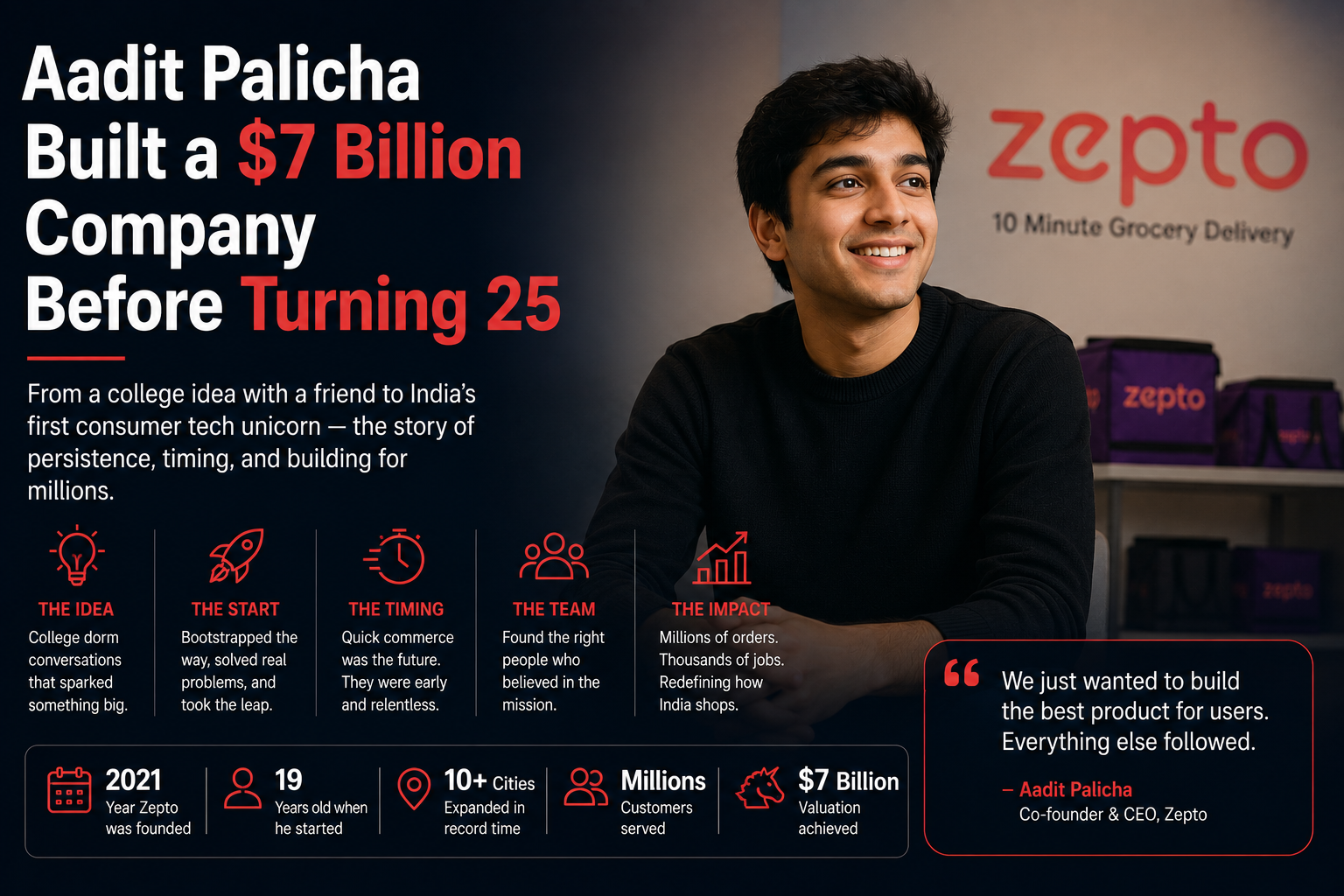
Aadit Palicha was born in Mumbai in 2002 and spent much of his schooling at GEMS Modern Academy in Dubai, where he scored a perfect 45 out of 45 in the IB Diploma. He went on to Stanford to study computer science — and then, during the pandemic, made the decision to leave before finishing, choosing to build in India rather than complete his degree abroad. Alongside his school friend Kaivalya Vohra, he founded Zepto, originally incorporated as Kiranakart Technologies, in 2021.
Betting on a Category Investors Doubted
Zepto's core idea — grocery delivery in ten minutes, built on a dense network of dark stores rather than traditional retail — arrived at a moment when quick commerce as a category was widely dismissed as a low-margin, capital-burning experiment unlikely to survive its own unit economics. Palicha and Vohra built anyway, scaling the dark store network past 200 locations by late 2025 and toward 900, with daily order volumes climbing into the seven figures.
Turning Growth Into a Credible Financial Story
By FY24, Zepto's revenue had more than doubled to ₹4,454 crore, while its losses narrowed as a share of revenue — a shift Palicha highlighted directly, noting that the company had completed a full statutory audit by a Big Four firm with no financial qualifications, an unusually clean governance outcome for a startup only three years old. That governance discipline became part of Zepto's pitch to institutional investors: not just growth, but growth that could withstand public-market scrutiny.
The scale kept climbing. By FY26, Zepto's revenue from operations had reached ₹22,623.58 crore, even as its net loss also grew to ₹5,905.19 crore — a reminder that Zepto's version of success has always been about proving a durable path to profitability at massive scale, not proving profitability itself just yet.
From Confidential Filing to a Live IPO Process
Zepto's path to the public markets has moved in clear, disclosed stages: a confidential DRHP filed with India's market regulator in December 2025, formal submission of IPO papers in January 2026, a $450 million funding round in October 2025 led by CalPERS that valued the company at $7 billion, and an Updated DRHP filed in June 2026 targeting a fresh issue of roughly ₹8,010 crore alongside an offer for sale — positioning Zepto to become the first dedicated quick commerce company to debut on a domestic Indian stock exchange.
The process hasn't been without friction. Zepto's founders received summons from the Enforcement Directorate in April 2026 relating to the company's earlier Singapore holding structure and its reverse-flip back into an Indian entity — a compliance matter the company has said it has fully cooperated with by submitting the requested documentation.
Why It Matters for Business Success
Palicha's story is less a tale of overnight success and more a case study in what "success" looks like for a founder building a genuinely capital-intensive business: years of compounding losses treated as a deliberate, disclosed trade-off for market share, a governance track record built early enough to survive IPO-stage scrutiny, and a willingness to keep the company's real financial picture — growth and losses both — in public view rather than obscured until the last possible moment. Whether Zepto's eventual public listing validates that bet is still an open question the market hasn't answered. But the fact that a college dropout in his early twenties built a business capable of asking that question on India's stock exchange is, on its own, the success story.
Business Success Stories
At www.elevatexstudios.com / ElevateX Studios, Business Success Stories, part of our Entrepreneurs coverage, tracks the founders and companies turning ambitious early bets into businesses that can stand up to real market scrutiny.