Uday Kotak Thinks the Post-1945 World Is Over — And Indian Business Isn't Ready
At the CII Annual Business Summit 2026, the Kotak Mahindra founder told India Inc. to trade comfort for "strategic paranoia"
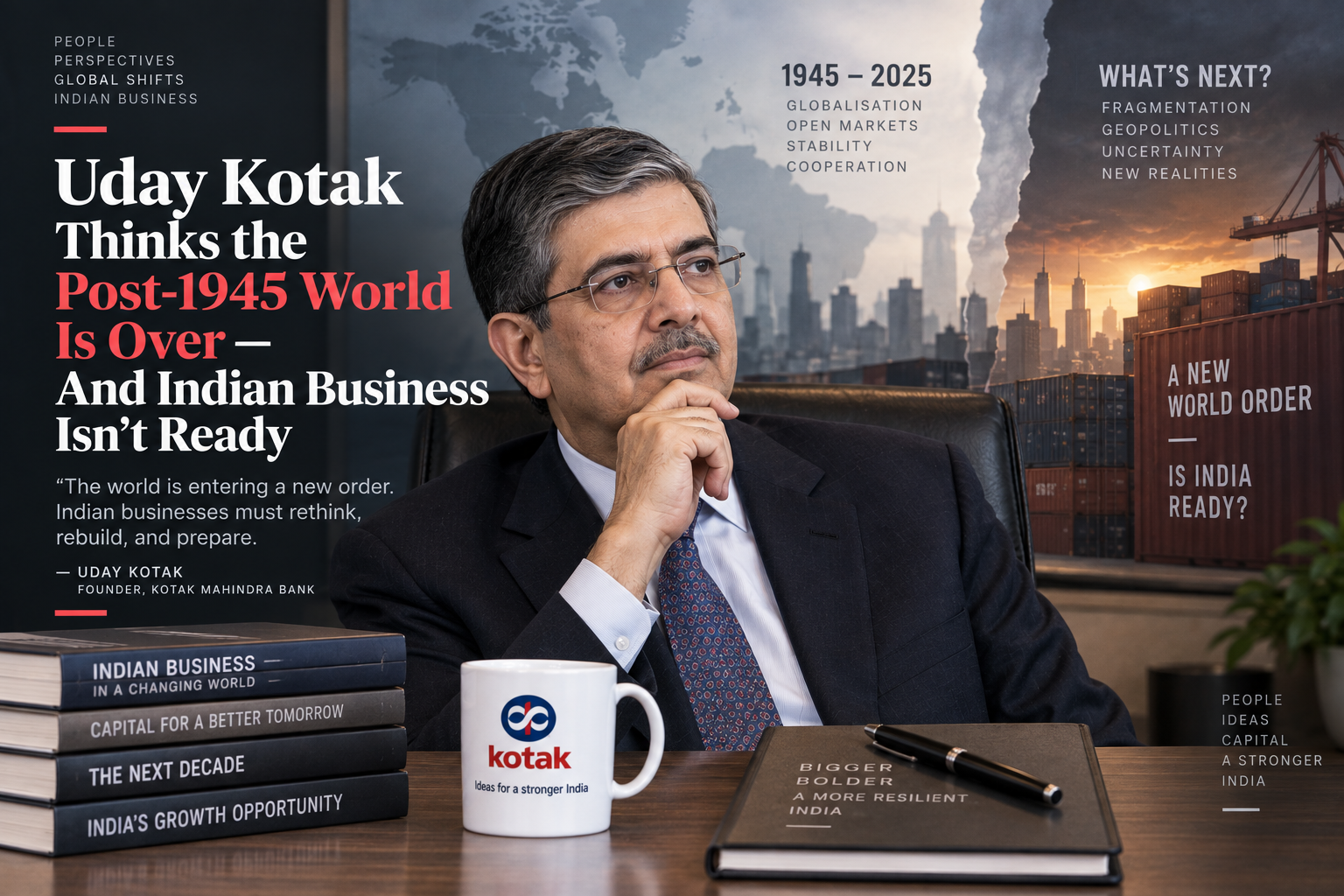
Uday Kotak has spent the past year delivering a consistent, increasingly urgent message to Indian business audiences: the 80-year era of relative global stability that followed 1945 is ending, and most companies are still operating as though it isn't. Speaking at the CII Annual Business Summit 2026, Kotak laid out a framework he's returned to repeatedly — that the world has historically reverted to "normal" after crises since World War II (what he calls Scenario 1), but is now entering a period of genuine Structural Change (Scenario 2) more comparable to the pre-WWII era, marked by a resurgence of tribal and nationalist mindsets and an AI-driven concentration of wealth in fewer hands than at any point in recent history.
The Politics-First Read on Global Finance
Kotak has been explicit that politics, not economics, is now the primary force reshaping global finance. Speaking at Business Standard's BS Manthan conclave, he argued that "every morning brings a fresh piece of information that can change our entire worldview," pointing specifically to how tariff decisions in sectors like automotive can instantly move Indian markets in ways that traditional drivers — interest rate changes, corporate earnings — used to dominate almost exclusively. His framing was blunt: in the current era, "power is power," and businesses that plan primarily around economic fundamentals while treating political risk as secondary are misreading the actual environment they're operating in.
Forty Years of Building, Now Watching From Outside the Day-to-Day
Kotak's perspective carries particular weight given his own trajectory — he started what became Kotak Mahindra Bank in 1985 at age 26, as a small bill-discounting operation, and built it into one of India's leading private banks, making history in 2003 as the first Indian non-banking financial company to convert into a full bank. Having since stepped back from day-to-day executive leadership to run USK Capital, his own family office, Kotak has been candid in interviews about how that transition changed him — telling Republic's Arnab Goswami in a "Legends" interview that he was more patient at 51 than he is now at 66, and that no longer managing a workforce that once exceeded 100,000 people has genuinely changed how he operates.
The Leadership Trait He Keeps Returning To
Across multiple interviews, Kotak has consistently named the same specific leadership quality as decisive: a leader's openness to hearing a contrarian point of view, distinct from whether they ultimately agree with it. He's framed this as more important than raw decisiveness — arguing that a leader who surrounds themselves only with agreement, however confident that leader may be, is structurally worse positioned than one willing to sit with genuine disagreement before making a call.
A Direct Challenge to Comfort
Kotak's sharpest recent framing has been aimed squarely at what he sees as complacency among Indian businesses, entrepreneurs and professionals. He's argued that a mindset of "everything is okay" needs to give way to genuine alarm about the next five years — using language like "shake up and wake up" to describe the mindset shift he believes Indian business urgently needs, given how much more secure and comfortable the current generation of Indian professionals has become relative to the environment he built his own career in.
Why It Matters for Business Leaders
Kotak's "strategic paranoia" thesis is a useful provocation precisely because it comes from someone whose own career was built during a genuinely uncertain period in Indian finance, not from someone speaking abstractly about disruption. His argument that businesses need to actively war-game a structurally different, more politically volatile global order — rather than assume today's stability is the default state to which markets will always revert — is a direct challenge to how most corporate strategic planning still implicitly operates.
Business Leaders
At www.elevatexstudios.com / ElevateX Studios, Business Leaders, part of our Interviews series, brings you the philosophies and governance choices behind the executives running some of Asia's most influential companies.