Harsh Jain Lost 95% of His Company's Revenue Overnight — and Refused to Cut a Single Job
The Dream11 CEO's account of rebuilding after India's real-money gaming ban is one of the most instructive founder interviews of the past year
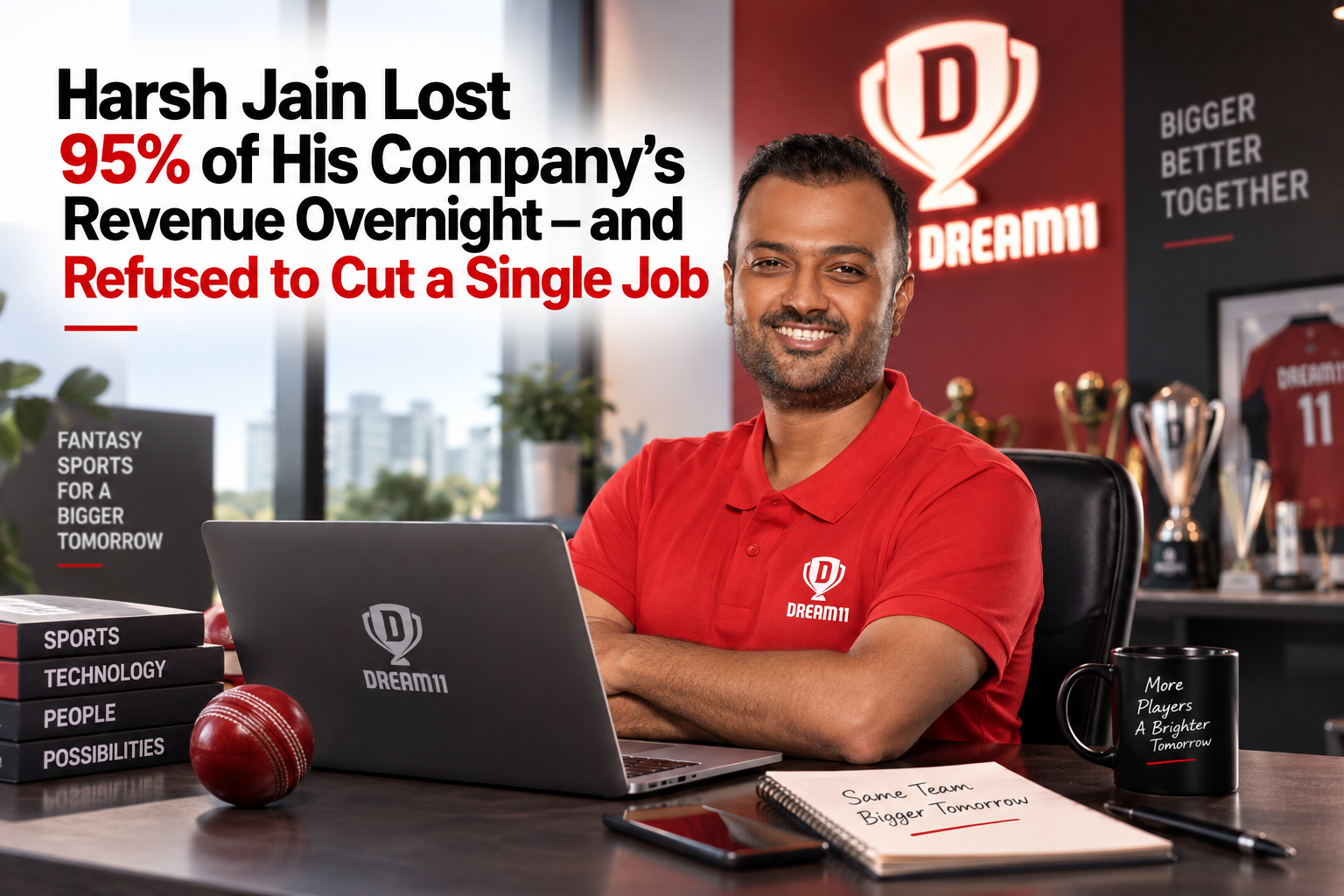
Few Indian founders have had to answer a harder question in public than Harsh Jain did in August 2025. Parliament had just passed the Promotion and Regulation of Online Gaming Bill, imposing a blanket ban on real-money gaming — a sector valued at nearly ₹2 trillion, employing more than 200,000 people and contributing roughly ₹25,000 crore annually in GST. For Dream11, India's largest fantasy sports operator, the effect was immediate and total. In an interview with Moneycontrol, Jain disclosed that 95 percent of Dream Sports' revenue and 100 percent of its profits had vanished essentially overnight, all of it tied to the cash-based contests the new law had made illegal.
The First Decision: No Layoffs
What Jain said next is the part worth studying. Despite losing nearly all of the company's revenue, he ruled out layoffs outright — telling Moneycontrol the company had no intention of downsizing and that all the talent at Dream Sports was safe. His reasoning wasn't sentimental. He argued that the only way to cope with losing 95 percent of your revenue is to build new products you can sell later, and that talent is necessarily the first step in doing that — not the first cost to cut. He pointed to sustained internal demand for that talent across Dream Sports' other businesses, including fintech venture Dream Money, Dream Game Studios, sports experiences platform DreamSetGo, and sports content and commerce platform FanCode, alongside a cash position he described as sufficient to last years.
Choosing Not to Fight
Equally notable was what Jain chose not to do. He confirmed publicly that Dream11 would not challenge the ban in court, opting for full compliance rather than a legal battle — while candidly acknowledging that the industry had failed to self-regulate effectively, and expressing concern about offshore betting platforms filling the vacuum the ban created. Calling the decision "a shock" while declining to contest it is a rare posture for a founder whose business model had just been legislated out of existence.
Dream11 3.0, and Then a Bigger Pivot
Jain initially framed the company's next phase as "Dream11 3.0" — a free-to-play fantasy ecosystem built on advertising, sponsorships, global expansion and AI, leaning on a user base of 250 million registered users and 10 million daily actives, with roughly 70 percent aged between 18 and 35. Early advertisers included Swiggy, Astrotalk and Tata Neu.
But by December 2025, the pivot went further than free-to-play fantasy. Dream11 announced it was exiting the fantasy gaming segment entirely and relaunching as a sports entertainment platform — a "second screen" for live sports, built around creator-led watch-alongs where fans react and comment in real time. Jain's framing was characteristically direct: no sports fan, he said, should ever have to watch a match alone. The company began onboarding creators and influencers with the promise that they would receive the lion's share of revenue.
The Harder Follow-Through
Jain has also been honest about the limits of his original no-layoffs position as the pivot deepened. In December, announcing the shift to a sports entertainment platform, he acknowledged that Dream11's roughly 1,000 employees would face restructuring, since the new business would require only around 200 people — a considerably harder message than the one he delivered four months earlier, and one he chose to state plainly rather than bury.
Why It Matters
Jain's interviews over this period are unusually valuable precisely because they track a founder's thinking in real time across a genuinely unprecedented shock — not a downturn or a competitive threat, but a law that eliminated an entire business model overnight. The sequence is instructive: protect people first, don't litigate the past, rebuild around what the company still has (a massive engaged user base, a strong brand, adjacent businesses), and then be honest when the new business turns out to need a fundamentally different organisation than the old one did.
Founder Interviews
At www.elevatexstudios.com / ElevateX Studios, Founder Interviews, part of our Interviews series, brings you founders' own accounts of the decisions, setbacks and turning points behind the companies they built.