Why Mathematics Matters Beyond the Classroom: Preparing Class 12 Students for the Future
At its core, Mathematics is a discipline that teaches students how to think. It encourages logical reasoning, structured problem-solving, analytical thinking and the ability to approach complex situations with clarity. These skills can remain valuable throughout higher education and across a wide range of professional
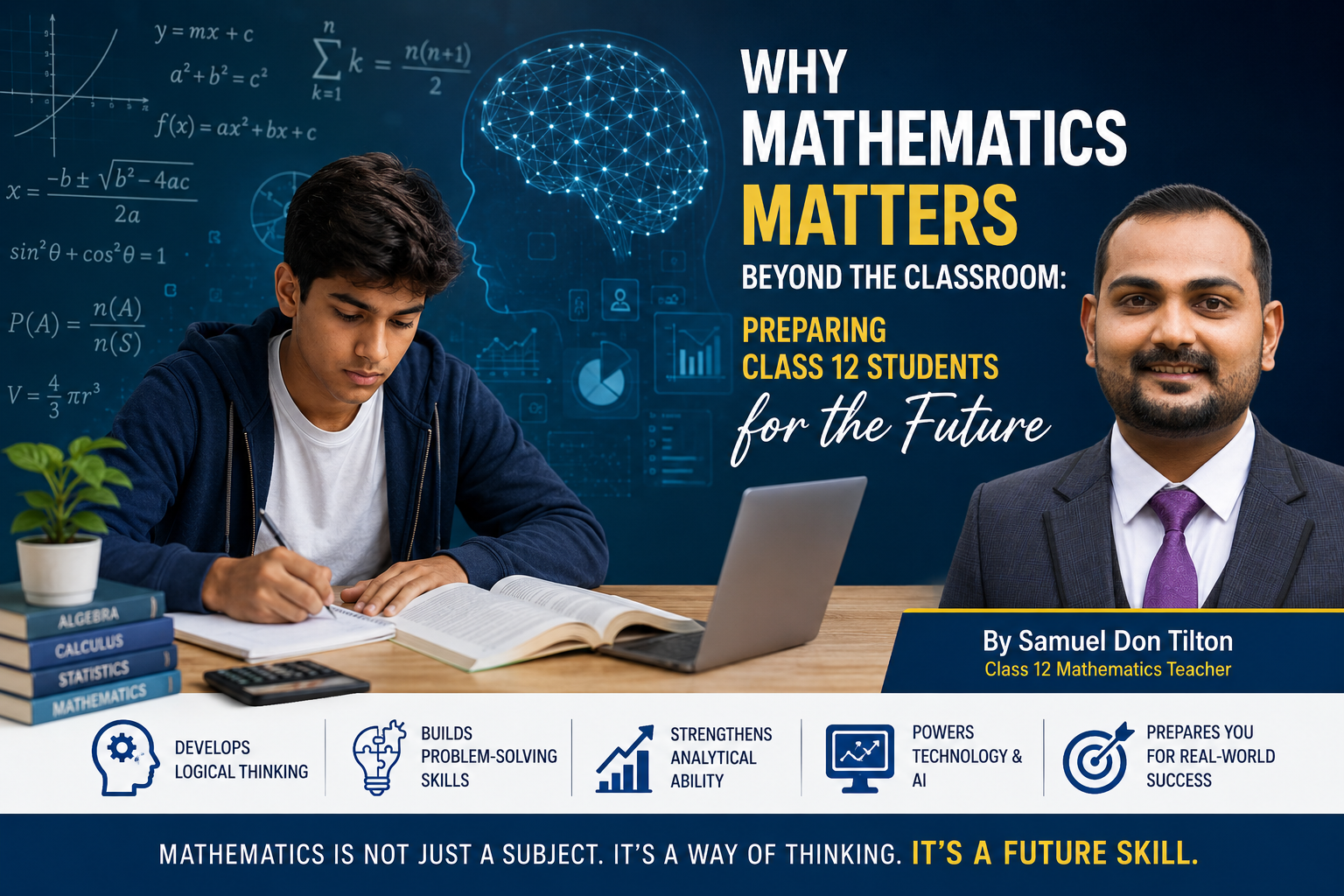
Why Mathematics Matters Beyond the Classroom: Preparing Class 12 Students for the Future
By Samuel Don Tilton, Class 12 Mathematics Teacher
For many Class 12 students, Mathematics is closely associated with board examinations, grades and academic performance. While examinations are undoubtedly an important milestone, the value of Mathematics extends far beyond marks.
At its core, Mathematics is a discipline that teaches students how to think. It encourages logical reasoning, structured problem-solving, analytical thinking and the ability to approach complex situations with clarity. These skills can remain valuable throughout higher education and across a wide range of professional careers.
Mathematics Beyond Board Examinations
Board examinations are important, but they represent only one point in a student’s educational journey.
Students often approach Class 12 Mathematics with the immediate objective of performing well in their examinations. However, an exclusive focus on marks can sometimes overshadow the broader skills that the subject develops.
Mathematical learning requires students to understand concepts, interpret information, identify patterns, apply appropriate methods and arrive at reasoned conclusions. This process helps develop habits of thinking that can be transferred to subjects and situations beyond the mathematics classroom.
The ability to break a complex problem into smaller, manageable components is particularly valuable. Whether students eventually work in technology, business, science, finance, education or other fields, structured thinking can help them approach challenges more effectively.
Building Strong Problem-Solving Skills
One of the most significant benefits of studying Mathematics is the development of problem-solving ability.
A mathematical problem rarely requires students simply to recall information. They must first understand what is being asked, identify the relevant information, select an appropriate strategy and evaluate whether their solution is reasonable.
This process encourages students to approach challenges systematically rather than relying solely on memorisation.
In my experience, students become more confident in Mathematics when they begin to see a difficult question not as an obstacle, but as a problem that can be broken down and solved step by step. That mindset has value far beyond examinations.
Understanding Rather Than Memorising
One of the challenges students sometimes face is treating Mathematics as a collection of formulas and procedures to be memorised.
Formulae certainly have their place, but genuine mathematical understanding goes further.
Students benefit when they understand why a method works, when it should be applied and how it can be adapted to a new situation. This becomes particularly important when they encounter application-based or unfamiliar questions.
That transition—from remembering a method to understanding it—is an important stage in mathematical maturity.
Developing Logical and Analytical Thinking
Mathematics trains students to examine information carefully and establish relationships between different elements.
A mathematical argument requires precision. A solution must follow logically from the information and assumptions involved. Students therefore learn to distinguish between an assumption and a fact, recognise relationships and evaluate whether a conclusion follows from the available evidence.
These habits can prove useful in everyday decision-making as well as professional environments.
Mathematics in the Age of Artificial Intelligence
Artificial intelligence may appear to be primarily a technological field, but its foundations are deeply connected to Mathematics. Concepts such as statistics, probability, algebra, calculus and optimisation play an important role in how AI systems learn from data, identify patterns and make predictions.
This connection makes the study of Mathematics particularly relevant for students growing up in an increasingly technology-driven world. Students may not all become programmers or AI specialists, but understanding the mathematical ideas behind technology can help them use it more intelligently and critically.
AI can provide answers quickly, but students still need the ability to question those answers, interpret data, recognise patterns, identify errors and determine whether a conclusion is reasonable. These are precisely the kinds of skills that mathematical thinking can develop.
The aim is not to make every student a mathematician or technology specialist, but to give them the mathematical foundation to understand, evaluate and adapt to the technologies shaping their future.
Conclusion: Mathematics as a Foundation for Your Future
For Class 12 students, Mathematics should be seen as more than a subject to be completed, examined and eventually left behind. Its deeper value lies in the habits of thinking it develops—questioning assumptions, recognising patterns, analysing information, solving problems systematically and persisting when the answer is not immediately obvious.
As education and the world of work continue to evolve, these abilities are becoming increasingly important. Technology may change the tools students use and the careers they enter, but the capacity to think logically, interpret information and make sound decisions will remain fundamental.
The challenge for educators, therefore, is not simply to help students achieve higher marks, but to help them understand why what they are learning matters. When students begin to see Mathematics as a way of thinking rather than merely a collection of formulas, the subject takes on a much greater significance.
For students preparing to step beyond school, that may be the most enduring lesson Mathematics can offer: the ability to approach unfamiliar problems with curiosity, reason through complexity with confidence, and keep searching for a solution.
In this sense, the true achievement in Mathematics is not measured only by the marks earned in a Class 12 examination, but by the thinking skills students carry with them into higher education, their careers and the wider world.