How the India-US Tariff Deal Reshaped the Trade Conversation in 2026
From a punishing 50 percent to 18 percent — the interim agreement that pulled Indian exporters back from the edge, and the trade deficit numbers still testing its impact
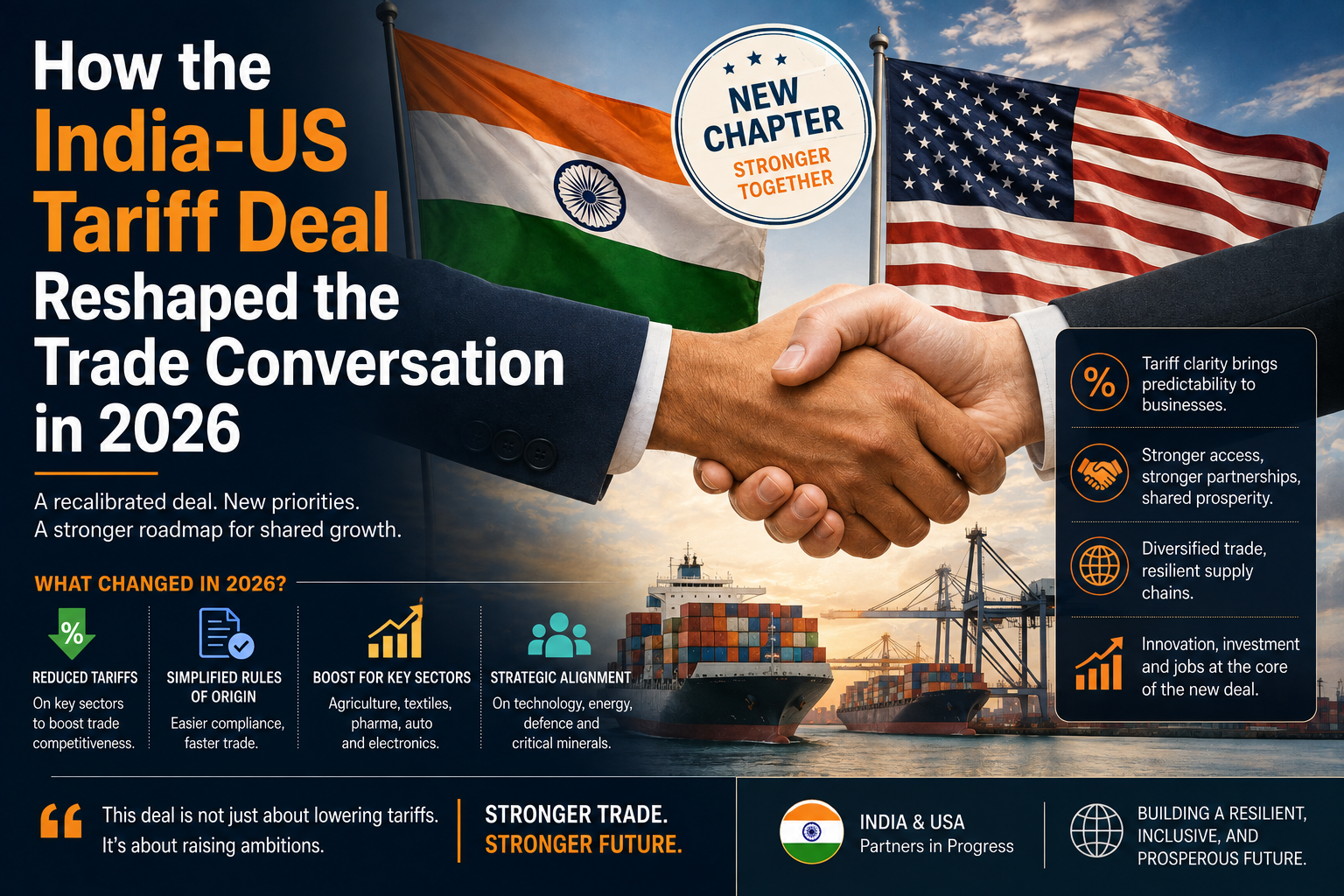
Indian exporters spent much of late 2025 bracing for the worst. In August 2025, the United States had imposed a 25 percent punitive tariff on Indian goods over India's continued purchases of Russian crude oil, stacked on top of an existing 25 percent reciprocal tariff — pushing the effective rate on Indian exports to the US toward 50 percent, among the harshest treatment any major US trading partner faced.
That changed on February 2, 2026, when President Trump and Prime Minister Modi announced an interim trade agreement cutting the reciprocal tariff from 25 percent to 18 percent, effective immediately, while the punitive 25 percent duty was separately removed in recognition of India scaling back Russian oil purchases. Commerce and Industry Minister Piyush Goyal said the reduction leaves India with a lower tariff rate than regional competitors including China, Bangladesh, Vietnam and Pakistan — a competitiveness gap Indian exporters in textiles, gems and jewellery, and engineering goods have been counting on.
What India Gave Up in Return
The deal wasn't one-directional. Under the framework, India committed to eliminating or sharply reducing tariffs on US industrial goods and a range of American agricultural products, including items like dried distillers' grains, while maintaining protections for its own agriculture and dairy sector, according to both Indian and US officials. In exchange, a set of Indian agricultural exports — including spices, tea, coffee, cashews and several fruits — are set to enter the US duty-free. Goyal has framed the broader ambition as pushing bilateral trade toward ₹45 lakh crore in the coming years.
A Deal That Survived a Legal Curveball
The agreement's durability was tested almost immediately. When the US Supreme Court struck down a broader set of Trump-era tariffs in February 2026, there was real uncertainty about whether the India deal would be affected. Trump moved quickly to clarify that the India arrangement remained unchanged, reaffirming the 18 percent rate at a White House press conference the same week — a signal that Washington viewed the India deal as a bilaterally negotiated agreement distinct from the tariff authority the Court had just curtailed.
The EU Deal Running in Parallel
India wasn't only recalibrating its US relationship. Around the same period, India and the European Union moved to conclude long-running free trade negotiations, which officials on both sides described as one of the most significant trade agreements either side has completed in years. As part of that pact, India agreed to cut tariffs on EU car imports to 40 percent from levels that had run as high as 110 percent for vehicles priced above €15,000, with further reductions to 10 percent planned over time — a move expected to ease access for European automakers while India's own exporters gain improved access to the EU market.
The Numbers Still Tell a Mixed Story
Lower tariffs haven't yet translated into a narrower trade gap. India's merchandise trade deficit has continued widening through the first months of 2026, driven substantially by a jump in gold and silver imports alongside rising freight costs and supply disruptions tied to tensions in West Asia. Exporters in apparel and manufacturing have reportedly begun adjusting shipment schedules and exploring alternative routes to manage higher logistics costs, a reminder that a friendlier tariff rate doesn't automatically offset broader cost pressures elsewhere in the supply chain.
Why It Matters for Global Business
The India-US and India-EU trade developments this year illustrate how much of global trade policy in 2026 is being negotiated bilaterally and under real time pressure, rather than through slower multilateral frameworks. For companies with exposure to Indian exports or the Indian consumer market, the practical takeaway is that tariff relief has arrived — but it's arriving alongside currency, freight and geopolitical pressures that are still shaping the numbers on the ground.
Trade & Commerce
At www.elevatexstudios.com / ElevateX Studios, Trade & Commerce, part of our Global Business coverage, tracks the tariff decisions, trade agreements and cross-border deals shaping how goods and capital move in and out of India.
